
What’s in a name… I am often asked why Canute Road Quay…

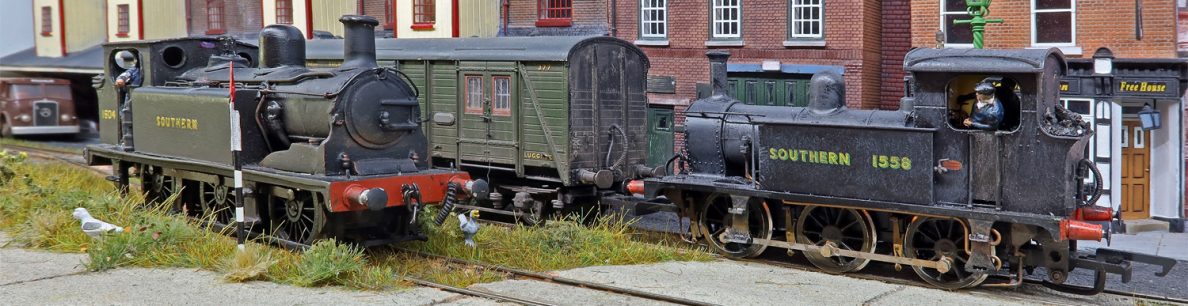
The arrival of the excellent Model Rail Magazine commissioned USA Tanks (which I had a slight hand in the development for), and already having a kit built Adams B4 (prior to the arrival of the Dapol versions) got me thinking about a quayside type scene, but obviously not based directly on a specific Southampton Dock location, but with a big hint to its location, and Canute Road Quay was knocked together over a 6 month period.
The London and Southampton Railway (renamed London and South Western Railway during 1839) first reached Southampton from London in June 1839 terminating firstly at Northam, and then extended (as originally planned) to Terminus Station in May 1840 and that kick started the expansion of the docks that had a maritime heritage since the Roman era. The economic prosperity of the town was driven by the development of the railway and the construction of the Eastern Docks, and these led to the increased development of the area to the east of the old town walls, including Canute Road.

The first main dock was established in 1843 which became known as Outer Dock in 1851 when the now filled in Inner Dock was created.
In 1892 the London South Western Railway became the owner and operator of the docks, which passed to the Southern railway in 1923.
The Southern Railway continued to develop and build new docks such as the ‘New Docks’ (now known as Western Docks) started in 1927, filling in the bay between the town of Southampton and Millbrook, and opened in 1934, and the Ocean Docks, which gained an Art Deco terminal building in 1950.
At the western end of the docks was a new dry dock, the King George V Graving Dock. Opened in 1933 this dock was the largest in the world.
With nine new deep water berths, the new Western Docks created the space that Southampton docks had needed as the size of ships had been steadily increasing.

With more space for liners in the new docks, Southampton was also able to attract new operators, inclduing famous shipping lines such as: Cunard White Star , Orient Line and Peninsular and Oriental Steam Navigation Company. From 1934 Imperial Airways began using Southampton for their flying boat services.
Canute Road was the main route to the new docks and railway station, and its importance to the commercial life of the town is reflected in the buildings that were developed along the road including The South Western Hotel, public houses, shipping agents, banks, a Board of Trade office, Post Office and a Customs House.
Rail access to the east of the docks was alongside Southampton Terminus station between it and the large LSWR goods shed that had been built in 1882 occupying what was St Lawrence road.
Southampton Terminus station itself closed in September 1966.
Although the station platform area and yard has been converted to car parking and housing the 1840 terminus station building (now a casino), the South Western Hotel and the large LSWR good shed (now car parking) have survived.

After the construction of the Western Dock in 1934 a further rail access to the docks via Millbrook was opened.
Several tracks ran across Canute Road, at the now famous often photographed ungated level crossing, requiring flagmen, to the eastern docks to serve the cargo ships and passenger liners. Of these tracks, only one now remains in use.
For many of the ocean liner services a number of special boat trains would be run for both arriving and departing passengers.

These boat trains ranging from full pullman car formations for first class passengers and ordinary coaching stock for 2nd and third class passengers. The Southern maintained three classes of coaching stock specifically for these services.
One of the lines crossings here was the original Southampton Harbour Board tramway that turned and ran west actually along Canute Road before entering the docks opposite the South Western Hotel towards the Harbour Board building and Royal Pier.
As stated above using the name Canute Road Quay for my layout obviously provides the setting without being based on a specific location within Southampton Docks as in reality it is probably not on Canute Road itself but more likely to the east being a quay accessed by the river Itchen, similar to other many railway connected wharfs, such as Dibles, Belvidere, Victoria, James, Gas works, Union, Burnley and Phoenix Wharfs (see maps above).
 The 8th / 9th June sees Canute Road Quay appearing practically at its spiritual home, being exhibited at Albert Road that is literally the road next to the real Canute Road, (between it and the old LSWR Goods shed) at the Southampton Trams Museum model event at the (Solent Sky Museum) Albert Road South, Southampton, SO14 3FR
This event that features a mix of model tramway and railway layouts is to raise funds for the Southampton Trams Museum and the restoration of Southampton Tram 57, please come along to help support this project by visiting the show in a fascinating location amongst the 20 or so heritage aircraft also on display!
I have a faint memory of being driven through the docks area when I must have been around 6 or 7 years old and being fascinated by the railway tracks threading their way over the roads.
Most interesting write-up Graham, thank you. It has been well over two decades since I had to deal with ‘issues’ at Canute Road!
In terms of the 1947 photograph of N15 no.774 is that HW Maunsell set 205 behind the locomotive (can’t quite read the number)?
Introduced in 1930 as a 4 Cor, set 205 was strengthened to 6 Cor by the 6th October 1946 CWNA.
Hi Colin, yes it is set 205. Thanks for the additional information.
Graham, thank you.
Please, could I use a higher resolution copy on the Maunsell High Window set page I’m preparing for BloodandCustard?
Colin
Hi Colin, I am afraid I don’t have a higher resolution version than that I used on the post than the clickable larger version.
Can someone help me please I am trying to find out what named Lord Nelson or King Arthur pulled the test train to Southampton docks in December 1930 before passenger services commenced in 1931.